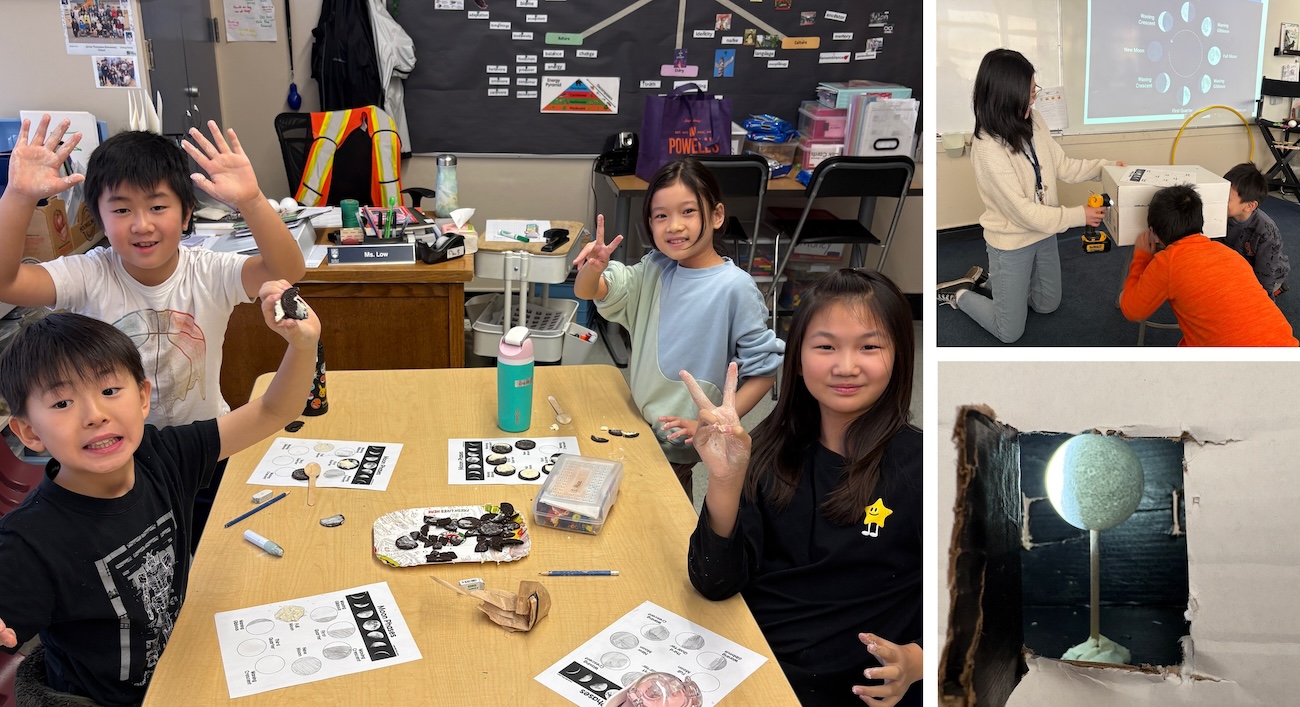
A cardboard box sat on a classroom stool, its small window revealing a glowing “moon” inside. Kneeling beside it, students leaned in closely, watching how light struck a Styrofoam sphere and changed its shape. What began with the question, “Why does the moon change shape?” grew into a month-long inquiry connecting science, math, literacy and art.
Using the handmade “moon box,” the class observed how sunlight reflected off the moon, sketching shadows and learning the names of each phase. In a standing model activity, the students took the place of the Earth, holding model moons and tracking how orbit created the phases visible from home. Oreo cookies later became edible diagrams, shaped to represent crescents, quarters and gibbous moons while reinforcing fraction concepts.
Beginning with February’s Full Snow Moon, the class kept a daily journal, recording what they noticed in the night sky and during crisp morning walks when the moon lingered overhead. The inquiry also explored the significance of the 13 Moons in Indigenous cultures and introduced moon stories from communities around the world.
It concluded with original creative writing and artwork inspired by their observations and evolving understanding, bringing together science, story and personal reflection under one shared sky.